Key Takeaways
- A safety-grade RTLS platform combines buttons and tags, a location network, and software to show where people and equipment are in real time.
- Hospitals use RTLS for staff duress alerts and equipment tracking.
- An RTLS platform built for safety has to cover every location where staff work, including stairwells and parking garages.
- Alerting nearby colleagues can get help to staff within 30 to 60 seconds, compared with 4 to 6 minutes on average for a conventional security response.
- Canopy runs duress alerts and equipment tracking on one LocationID Network.
A real-time location system (RTLS) is a platform that uses wearable buttons, tags, and fixed sensors to show where people and equipment are inside a building as they move. The software component of an RTLS platform turns data into action by displaying duress alerts, patient safety notifications, and equipment location. In a hospital setting, security can reach a staff member who pressed a duress button, and nurses can pull up the nearest available infusion pump on a map.
Hospitals can use safety-grade RTLS to track equipment, keep at-risk patients safe, and get help to staff during a violent incident, all using the same infrastructure. To ensure that help arrives quickly, a safety-grade RTLS that finds a missing pump also has to deliver a duress alert in seconds. This guide covers how healthcare RTLS works, how hospitals use it, and what to look for when one platform has to protect staff as well as track assets.
How is RTLS used in Healthcare?
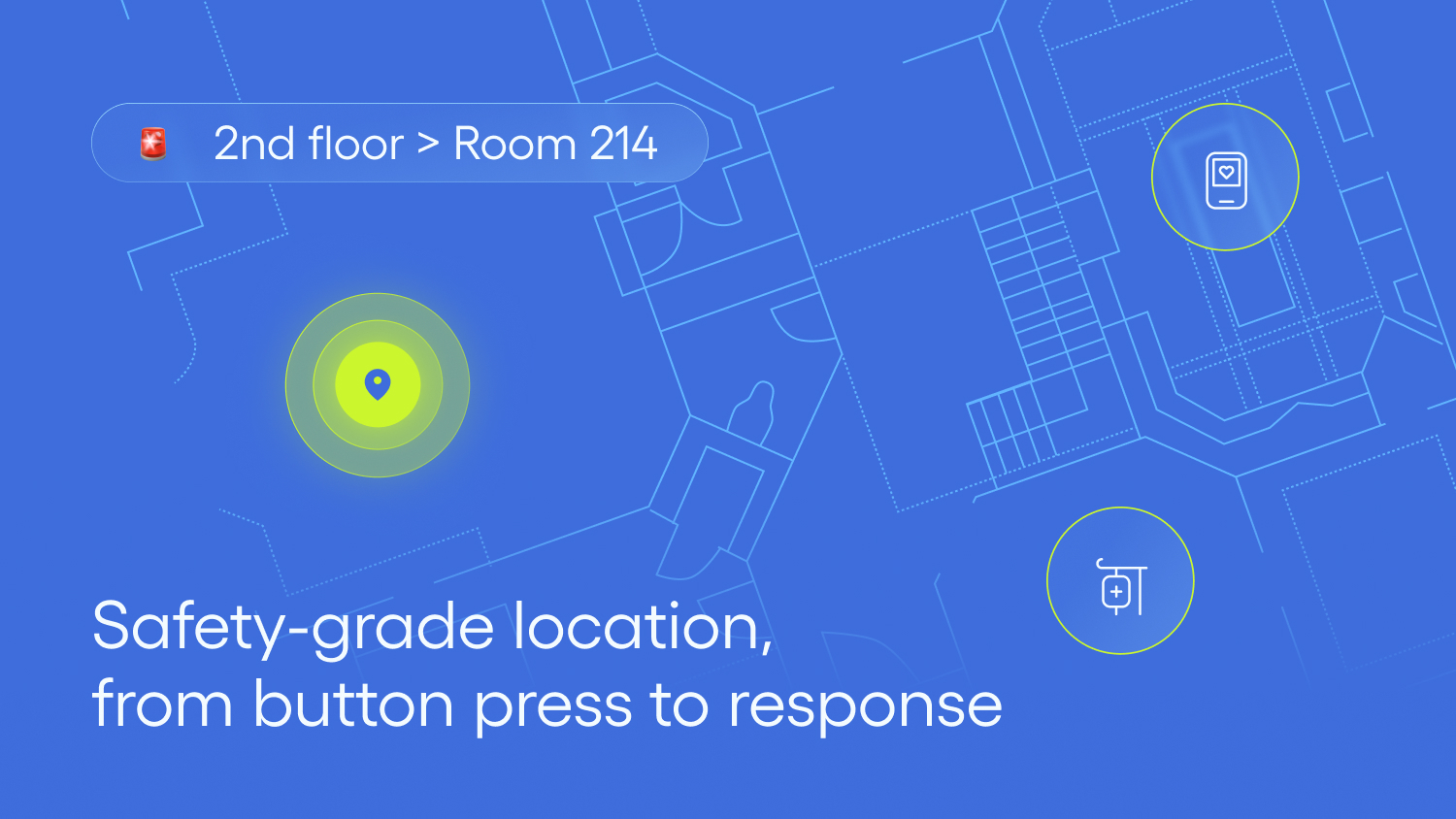
Researchers define RTLS as "local systems for the identification and tracking of the location of assets and/or persons," according to a primer on RTLS in healthcare published in the International Journal of Health Geographics. An RTLS is built to cover a defined space, such as a hospital campus, and works through walls and floors where satellite signals drop out. Healthcare RTLS can report location at the building, floor, or room level. That's precise enough to send a responder to the right door or tell a biomedical technician which closet holds the equipment they need.
An RTLS platform pairs that location data with software that acts on it. A security team gets a duress alert, a charge nurse gets a notification when a patient crosses a boundary, and a supply chain manager gets a report on equipment that sits unused.
How Does a Safety-Grade RTLS Platform Work in Hospitals?
Every RTLS platform has three core parts, and each affects how well the system holds up in a busy hospital.
- Buttons and Tags
Each person or item the system locates carries a small device with its own unique ID. Staff typically wear a button, often clipped behind their ID card. Equipment gets a durable antimicrobial tag built to survive cleaning and transport.
Battery life is worth asking about at hospital scale. A health system may have thousands of buttons and tags in use, so devices that need regular charging or battery swaps add maintenance work. Long-life batteries that don’t need recharging keep staff covered without the upkeep.
- The Location Network
Fixed sensors, called gateways, are mounted throughout the facility. They pick up signals from nearby badges and tags and pass them to the software that calculates each device's location.
Vendors build these networks on Wi-Fi, Bluetooth Low Energy (BLE), infrared, ultrasound, or ultra-wideband, and the technologies differ in accuracy, cost, and installation effort. Some reuse a hospital's existing Wi-Fi access points, while others run on a dedicated network of their own.
- Software and Alerts
A location engine takes the signals from the network and calculates where each button or tag is. Applications then turn that location into something staff can use: a floor map showing the nearest available wheelchair or a duress alert routed to security.
The software also keeps a record of every alert and movement. Leaders use that history to spot where incidents cluster, which equipment goes underused, and where response times lag.
What Problems Does RTLS Solve in Healthcare?
Staff duress alerts are the most time-sensitive use of RTLS in a hospital, and they get their own section below. The other common use is equipment tracking.
Equipment Tracking
Infusion pumps, wheelchairs, ventilators, and other mobile equipment constantly move between units. When staff can't locate what they need, they spend time searching, hoard equipment on their own unit, or wait on expensive rentals. RTLS shows where each tagged asset is in real time, and utilization data helps hospitals reduce losses and avoid buying or renting equipment they already own.
How Does RTLS Improve Staff Safety in Hospitals?
A nurse is alone in a patient room on a night shift when the patient becomes agitated and moves between the nurse and the door. The nearest panic button is mounted on the wall across the room, requiring the nurse to turn their back on the patient and also alert the patient to their call for help. With a wearable duress button on an RTLS network, the nurse can double-press the badge on their chest, and security and nearby colleagues know exactly which room to head to.
Health care and social assistance accounted for 72.8% of all private-industry workplace violence cases in 2021 and 2022, according to the Bureau of Labor Statistics. Since January 1, 2022, The Joint Commission has required accredited hospitals to run a workplace violence prevention program that includes a process to report incidents and analyze trends.
RTLS improves staff safety in three ways.
- Faster response: the alert goes out from wherever the staff member is, and the location updates if they move.
- Help from the people closest by: the platform can notify nearby colleagues along with security. Trusted colleagues can arrive within 30 to 60 seconds, compared with 4 to 6 minutes on average for a conventional security response, according to Canopy's analysis of why proximate notifications matter.
- Data that supports prevention: every alert is logged with a time and place, and incident heat maps show leaders where and when risk concentrates. That history feeds the trend analysis The Joint Commission requires.
For a deeper look at the risks staff face, read Canopy's guide to workplace violence in healthcare.
What’s the Difference Between RTLS and a Duress Button System?
RTLS is the location infrastructure, and a duress button system is one application that can run on it. A fixed panic button reports where it's mounted and only helps when someone can reach it. A wearable duress button on an RTLS network goes with the staff member and reports where they are. Canopy's comparison of hospital RTLS and duress alert systems breaks down how a modern platform differs from fixed panic buttons, basic mobile apps, and siloed RTLS systems.
What to Look for in a Safety-Grade RTLS Platform
In equipment tracking, a delay or a dead tag is a nuisance, but not a disaster. The same can’t be said for a staff duress alert. When a hospital uses RTLS to protect staff, the platform has to meet a higher standard, sometimes called safety-grade RTLS. Security, nursing, IT, and executive leaders evaluating an RTLS platform for staff safety should look for eight things:
How Canopy's RTLS Platform Locates People and Equipment
Canopy built its platform around staff safety first, then extended it to equipment. Every Canopy product runs on Canopy's LocationID Network, which uses dedicated indoor and outdoor gateways to cover the whole campus, including parking garages and remote areas. Canopy's how it works page walks through the full flow, from button press to dashboard.
- Canopy Protect: wearable duress alerts for hospital and campus staff. A double-press of the discreet Canopy Button sends an alert with precise location to security and nearby colleagues. The button has a 7-year battery with no charging, and the service includes proactive system monitoring, alert delivery oversight, and 24/7 support.
- Canopy Find: real-time location for critical mobile assets, such as wheelchairs and IV pumps, so staff can locate needed equipment in seconds. Assets appear on a map with search and utilization reporting.
- Canopy Go: duress alerts for home health and other mobile staff, using the same CanopyButton and smartphone GPS once they leave the campus.
Canopy now protects more than 350,000 healthcare workers across 2,000+ locations, and customers see an average 30% reduction in assaults in the first 6 months.
To learn how a safety-grade RTLS platform protects staff on a hospital campus, explore Canopy Protect.
FAQ
What is an RTLS platform?
An RTLS platform is a real-time location system plus the software that puts location data to work. It combines wearable buttons and tags, fixed sensors, and applications for alerts, search, and reporting. Hospitals use RTLS platforms to locate staff, patients, and equipment indoors.
Can one RTLS platform locate both people and equipment?
Yes. Buttons for staff and tags for equipment can all run on the same location network. That lets a hospital support duress alerts, patient safety, and equipment tracking without building a separate system for each.
Does RTLS require new hospital infrastructure?
Not always. Wi-Fi-based RTLS can reuse a hospital's existing access points, while systems built on a dedicated network add gateways throughout the facility. Hospitals should ask vendors about installation time, construction needs, and who maintains the network after go-live.
How accurate is RTLS in a hospital?
Hospital RTLS systems can locate buttons and tags at the building, floor, or room level. Accuracy depends on the technology and how densely sensors are installed. For staff safety, room-level accuracy matters most, because responders need to know which door to open.
Is RTLS the same as GPS?
No. GPS relies on satellite signals that weaken or drop out inside buildings, and RTLS uses a local network of sensors inside the facility. Some platforms, such as Canopy Go, use smartphone GPS to extend coverage to staff working off campus.